
Inclusive Anatomy
Eponym:
Korbinian Brodmann (1868 – 1918) was a German neuropsychiatrist renowned for his work on cortical cytoarchitectonics. Born in Liggersdorf, Prussia, he extensively studied medicine at the universities of Munich, Würzburg, Berlin, Freiburg, and Lausanne, earning his medical diploma in 1895. He was then awarded a doctorate in medicine in 1898 from the University of Leipzig, after successfully defending his thesis on chronic ependymal sclerosis.[1] In the year 1900, Brodmann briefly worked in the psychiatric clinic at the University of Jena, where he met Ludwig Binswanger, an influential pioneer in the field of existential psychology.[2] Brodmann would also work in the Municipal Mental Asylum in Frankfurt; interestingly, it is here where he would have a chance encounter with Alois Alzheimer, who greatly encouraged him to pursue a career in neuroanatomy.[1] These experiences would convince Brodmann to begin a mentorship with Oskar Vogt and Cécile Vogt-Mugnier in Berlin, which would shape his successive approaches to brain mapping.[1]
In 1909, Brodmann published Vergleichende Lokalisationslehre der Großhirnrinde in ihren Prinzipien dargestellt auf Grund des Zellenbaues (Comparative Localization Theory in the Cortex Based on Cytoarchitectonics), which introduced the first detailed map of the cerebral cortex, identifying 52 distinct regions, which he coined as the Brodmann areas.[3] This work remains foundational in neuroanatomy, linking cortical structure to function. In the human brain, Brodmann described 47 areas, which he numbered sequentially. Areas 48–52 were described in non-human primates and may not have direct homologs in the human brain.[4]
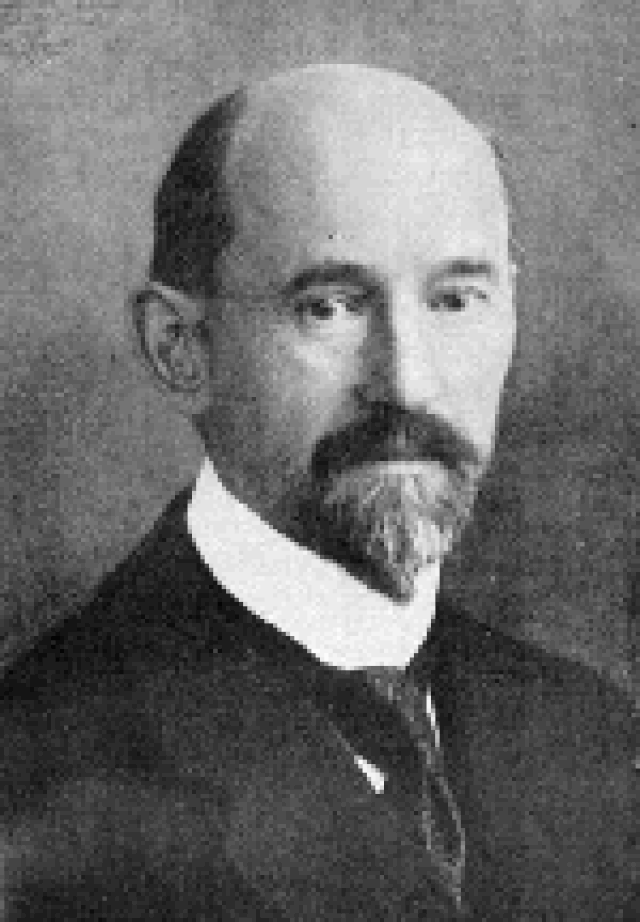
Korbinian Brodmann- Image Obtained From: Wikimedia Commons (Public Domain)
The groundbreaking nature of his work would award Brodmann with an abundance of employment opportunities in various hospitals across Germany. Brodmann would work his way up the ranks to eventually become the director of histology at the Psychiatric Research Center at the University of Munich in 1918. Unfortunately, Brodmann unexpectedly suffered septic complications following a bout with pneumonia, and tragically passed away at the age of 49 before he could begin his new position with the university.[1]
Scientific Contributions:
Brodmann’s work was highly influential in linking brain structure to function. His approach combined histology with neuroanatomy, bridging the gap between microscopic anatomy and behavioral neuroscience, and his numbered areas are still widely used in clinical and research settings to describe cortical regions. His contributions transformed the understanding of brain organization and continue to influence the study of the brain's architecture and function.[1] Brodmann's work has also significantly impacted clinical neuroscience. For example, functional mapping of disorders like aphasia, stroke, and Alzheimer’s disease frequently references Brodmann’s areas.[5] Beyond clinical applications, Brodmann's work has shaped scientific thought about the brain’s evolution and specialization. His comparative studies across species highlighted the continuity and divergence in cortical architecture, influencing modern evolutionary neuroscience.[1]
References
-
Zilles K. Brodmann: a pioneer of human brain mapping-his impact on concepts of cortical organization. Brain. 2018;141(11):3262-3278. doi:10.1093/brain/awy273
-
Hoff P. Otto Binswanger (1852–1929). AJP. 2002;159(4):538-538. doi:10.1176/appi.ajp.159.4.538
-
Brodmann K. Brodmann’s: Localisation in the Cerebral Cortex. 3rd ed. Springer; 2005.
-
Loukas M, Pennell C, Groat C, Tubbs RS, Cohen-Gadol AA. Korbinian Brodmann (1868-1918) and his contributions to mapping the cerebral cortex. Neurosurgery. 2011;68(1):6-11. doi:10.1227/NEU.0b013e3181fc5cac
-
Brodmann Area Involvement in Clinical Disorders. BioSource. November 18, 2024. https://www.biosourcesoftware.com/post/brodmann-areas-involved-in-clinical-disorders
We strive to ensure the accuracy of all content. If you notice any errors or have suggestions for improvement, please reach out to us so we can review and update the material accordingly.